
Home health aides share love of sports and patient care
April 2024
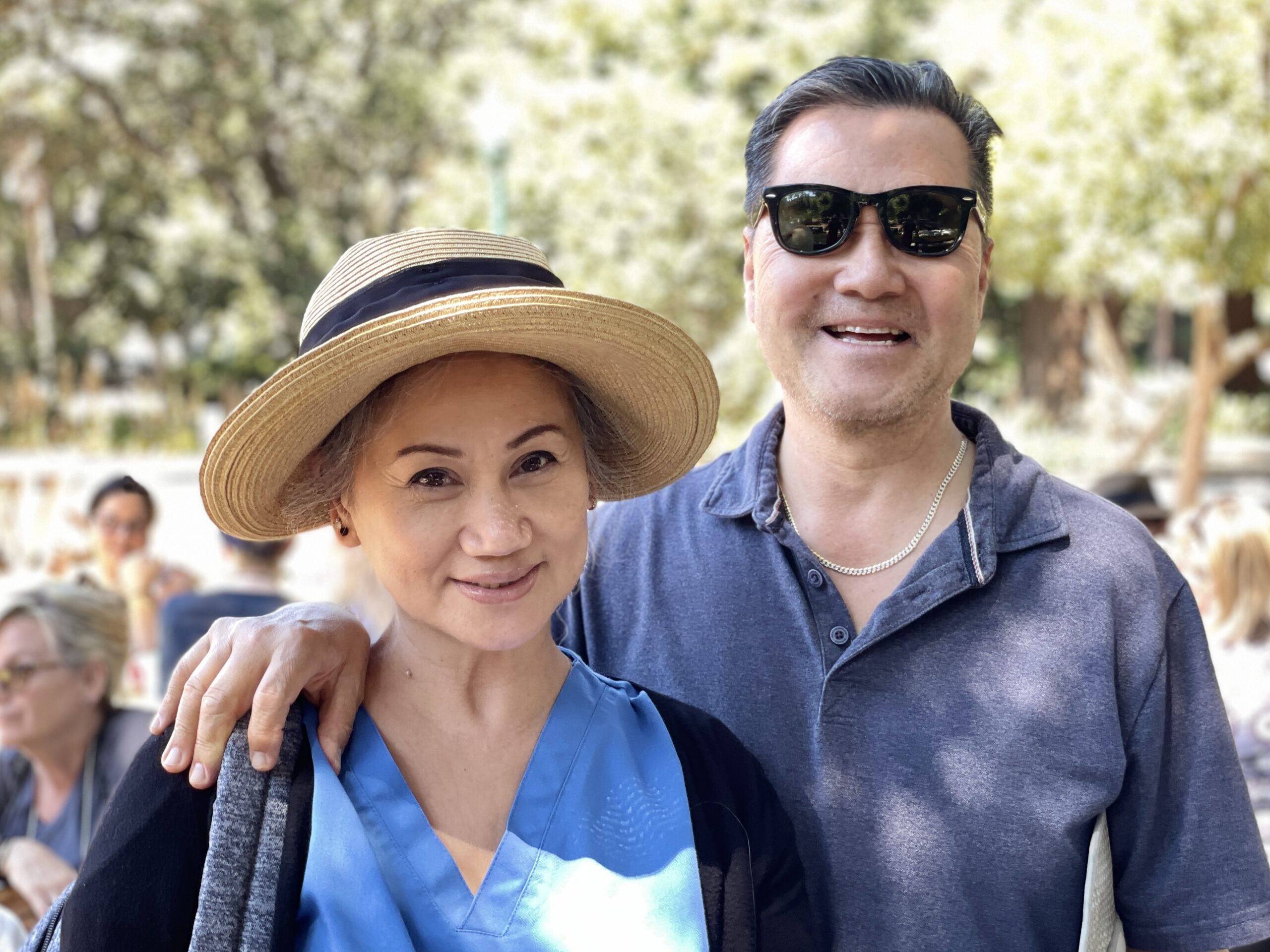 In any given conversation, both Tommy Joe and Gina Yamsuan are likely to bring up sports. They’re avid fans of all the local teams – Warriors, Giants, Niners – and more. The couple met and started dating when they were both working as home health aides (HHAs) at another hospice agency and found that their passion for sports was matched by their enthusiasm for their work.
Gina, who joined Mission Hospice more than 10 years ago, has been in health care most of her career; she loves having her own schedule and the flexibility that hospice offers. Tommy came to this work after a career in real estate. He switched careers after his mom became ill in 2000 and received hospice care. He became Mission Hospice’s first male HHA about six months after Gina joined the team.
The two of them, like all of our HHAs, travel throughout the Peninsula and South Bay to provide personal care to patients – bathing, hair care, dressing, transferring (helping patients move), and more. Tommy says he always thinks about what kind of care he would want if he were in the patient’s situation. “I like to picture myself in their shoes.”
“We always look forward to coming to work,” says Gina. “We actually help people. We make them happy, and they look forward to seeing us. They are so appreciative.”
Tommy and Gina both say they can’t imagine not working together. “It’s great doing the same job,” says Tommy.
“We can share our days, good or bad.”
“Tommy and Gina are very devoted to their patients and attuned to their needs,” says Hospice Clinical Manager Sue Kensill. “They truly get to know the families they visit, and they go the extra mile to provide patients comfort and dignity.”
Home health aides typically see patients two to three times per week. In addition to providing personal care for people, they teach their primary caregivers how to safely manage transfers, bathing, catheter maintenance, and more. “Doing this work,” says Gina, “we get really close with the family members too. They are so grateful for what we’re doing.”
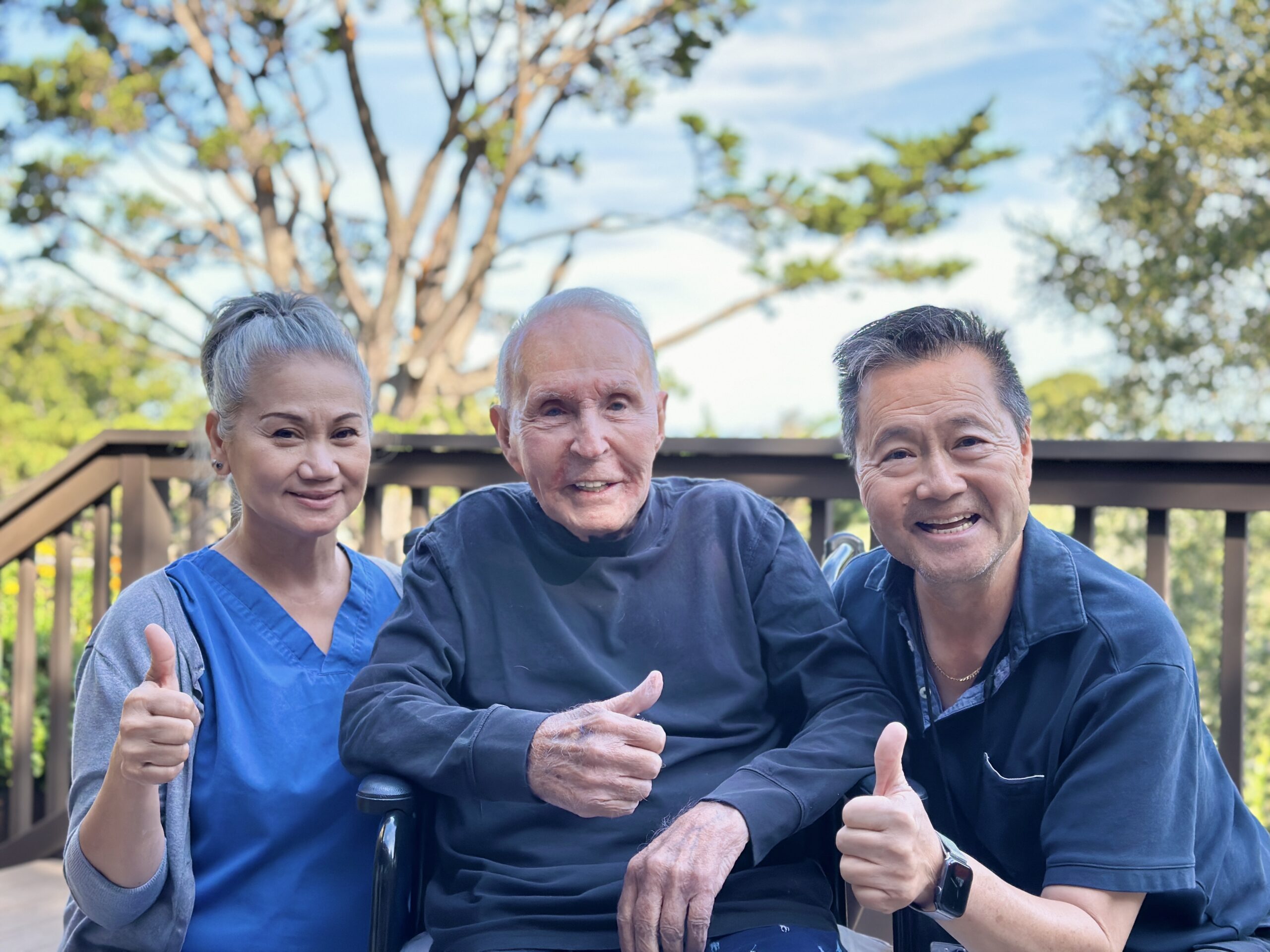 Since last September, Tommy and Gina have been visiting 91-year-old Martin in Menlo Park. Although Martin and his wife Priscilla were initially reluctant to have anyone in their home, they quickly hit it off with their Mission Hospice team – especially Tommy and Gina. Martin, as it turns out, is a former Golden Glove boxer with connections throughout professional sports and sports memorabilia throughout the house. “He knows everybody – all the players and coaches,” says Tommy. “Our conversations about the week’s games are a highlight for both of us. I have met a lot of clients, but Martin is very special.”
Martin’s wife Priscilla is grateful for the support the team offers. “Mission Hospice has been a godsend – it’s taken a weight off of me. Our nurse, Tommy and Gina, and our volunteers all visit every week. It helps me, and it gives Martin the stimulation of having someone else visit. I now see that hospice is about living life better – with help!”
Both Tommy and Gina love the connections they are able to make with people like Martin and Priscilla. “I can tell by the photos in the house what their interests are,” says Tommy. He remembers one patient who was slow to warm up to him, but when they started discussing the patient’s classic Thunderbird, they bonded over their love of cars. “We love to listen to the patients’ and families’ stories,” says Tommy. “It’s not work for us – we love it.”
Together, Tommy and Gina make quite a team. Their positivity radiates as they finish each other’s sentences. And they are always looking for special ways to bring joy to patients. One man was “grumpy” until Tommy started bringing him his favorite frozen drink, which he couldn’t get in his care facility.
“People say we’re the highlight of their day,” says Tommy. “They don’t realize it makes our day too. It’s a little perk we get – to see their joy.”
By the Bay Health, Mission Hospice & Home Care, and Hope Hospice Merge to Become the Largest Independent Not-for-Profit Hospice Network in Northern California
Newly combined organization aims to transform serious illness and end-of-life care with equitable access to high-quality, comprehensive, and integrated services across palliative, hospice, and home health care.
LARKSPUR, SAN MATEO, DUBLIN, Calif., November 30, 2023 — By the Bay Health, Mission Hospice & Home Care, and Hope Hospice today announced they will merge to become the largest independent not-for-profit hospice network in Northern California, uniquely positioned to provide compassionate care and impactful community services to more patients and families throughout the region.
The three organizations are among the longest-standing not-for-profit hospices in California: By the Bay Health was the state’s first hospice, while Mission was the first not-for-profit hospice in San Mateo County and Hope one of the earliest not-for-profit hospices serving the East Bay Tri-Valley.
The new network will increase equitable access to the San Francisco Bay Area’s most vulnerable populations by providing high-quality and comprehensive serious illness and end-of-life care including hospice, home health, palliative care, transitional care, pediatric care for children with chronic and serious illness, bereavement counseling, dementia support, and Mission House – the only residential hospice house on the Peninsula.
With the California Department of Finance reporting a 120 percent increase in the number of adults age 65 years and older projected to be living in the Bay Area by 2060, the new organization will be uniquely positioned to serve the growing needs of patients and families throughout the region. Together, it is anticipated that the new organization will have resources to serve more than 1,100 patients per day, supported by more than 500 community volunteers and 600 multidisciplinary staff. Through the new organization’s integrated, trans-disciplinary team-based approach to health care, patients and families will have comprehensive access to a clinically trained, compassionate team including physicians, nurses, social workers, spiritual support and bereavement counselors, home health aides, and physical and occupational therapists.
The combined organization will continue to partner with health care systems and community services throughout the Bay Area to provide a continuum of care for seriously ill patients and their families. By the Bay Health is an affiliate of UCSF Health, recognized worldwide for its innovative patient care, reflecting the latest medical knowledge, advanced technologies, and pioneering research. This affiliation remains in place expanding a comprehensive Bay Area network that addresses the multifaceted health needs of patients and families.
“Today is an incredibly proud day and a win for independent not-for-profit hospice organizations who put quality care and compassion over profit, working collaboratively through partnerships to ensure that all patients and families receive access to high quality, equitable care,” said By the Bay Health CEO Skelly Wingard, RN, MSN. “We are excited to partner with two respected and trusted mission-driven hospice organizations who deeply invest in, and care deeply about the local communities they serve. Together, we share a vision to transform care for our most vulnerable populations during one of life’s most important and honored moments.”
“Mission Hospice, By the Bay Health, and Hope Hospice share a rich history and commitment to serving the Bay Area community with comprehensive end-of-life care, education, and grief support,” said Mission Hospice CEO Dolores Miller, RN, MN. “Together, we can provide even more families the compassionate care and comfort they deserve at one of the most vulnerable times of life.”
“The vision of Hope Hospice was thoughtfully crafted 44 years ago by a small group of community leaders who wanted individuals to have every needed resource to care for loved ones in their final stages of life in the comfort of home,” said Jennifer Hansen, CEO of Hope Hospice. “Merging with these two excellent partners protects our legacy in the East Bay, and it secures access to additional quality resources and services. As a stronger combined organization, we can continue to provide compassionate end-of-life care that prioritizes the needs of patients and their families.”
About By the Bay Health
For nearly 50 years By the Bay Health, a not-for-profit affiliate of UCSF Health, has been a progressive and innovative leader in hospice, skilled home health care, palliative care, grief support, and pediatric care in the counties of Marin, San Francisco, San Mateo, Sonoma, Alameda, and the cities of American Canyon, Napa, and Vallejo. For more information about our service call (415) 927.2273 or visit www.bythebayhealth.org.
About Mission Hospice & Home Care
Mission Hospice & Home Care serves patients and families in the San Francisco Peninsula and South Bay with personalized, compassionate end-of-life care and education. Founded in 1979, the local, independent nonprofit has supported thousands of patients and their families through illness and bereavement. Donations from the community support their exceptional care and educational programs and help them serve people regardless of their medical coverage or ability to pay.
About Hope Hospice
Hope Hospice is a 501(c)(3) nonprofit organization that has been serving the Tri-Valley and adjacent East Bay since 1980. Hope currently serves approximately 2,000 individuals annually through its various service lines, including about 750 hospice patients per year. The addition of palliative care, dementia-care education, and family caregiver resources in recent years have made the organization stand out among local competitors. Donations and grants ensure that bereavement care and caregiver programs are available to the local public at no charge, even without having a loved one under Hope’s care. Learn more at HopeHospice.com.
Contact Details:
By the Bay Health
Caroline Kawashima, ckawashima@bythebayhealth.org
Mission Hospice & Home Care
Frances Freyberg English, ffreyberg@missionhospice.org
Hope Hospice
Kendra Strey, kendras@hopehospice.com
Nonprofit care: Putting patients over profit
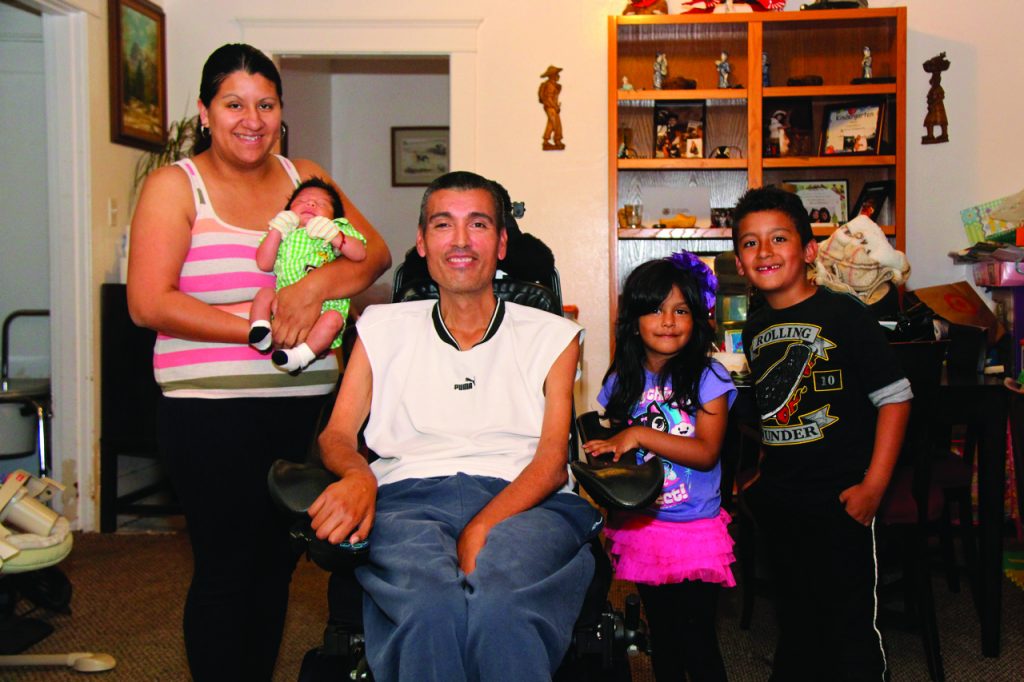 When two San Mateo residents founded Mission Hospice in 1979 as the area’s first nonprofit hospice, hospice care in the US was still new. Across the nation, nonprofit, community-based care grew, supported by volunteers who wanted to offer compassionate comfort for those in the last phase of life.
As hospice care became more accepted and Medicare began covering it, the number of hospice agencies increased dramatically. In the last two decades, there has been a huge shift: growth has been almost entirely from for-profit operations. Many nonprofits have been purchased by for-profit owners. Others have simply closed. Today, only about 20% of hospice agencies across the nation are nonprofit; in California, that number drops to 6%.
This has huge implications for patients, families, and their communities. Studies show a large gap in the level and kind of care provided by nonprofit hospices and for-profit companies, who have incentives to cut labor costs and select patients for whom care is less expensive.
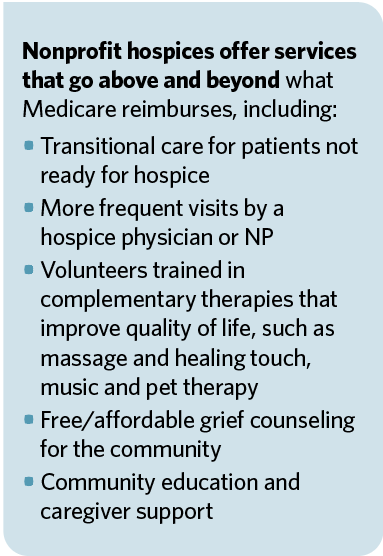 Because of their missions and community support, nonprofit hospices can prioritize patient needs rather than insurance reimbursements. Similarly, nonprofit hospices can care for patients who are uninsured, or whose insurance doesn’t cover the full cost of care.
Donors allow nonprofit agencies to provide more visits – nursing, social work, and therapy – and support more patients with intensive or specialized needs.
Nonprofit hospices also offer unreimbursed services and programs that families in their communities need, including caregiver training, support for advance care planning, youth grief camps, community workshops, and education for professionals and interns.
While many factors go into the decision to begin hospice care, the power to choose is yours. With a physician’s referral, you can start hospice care and select which agency you want to provide that care. You are free to stop hospice care at any time. While a physician may refer you to a particular hospice provider, you can always ask for a different organization.
Mission Hospice remains committed to the vision of our founders – that every person in our community has access to exceptional and compassionate end-of-life care.
End of Life Option Act
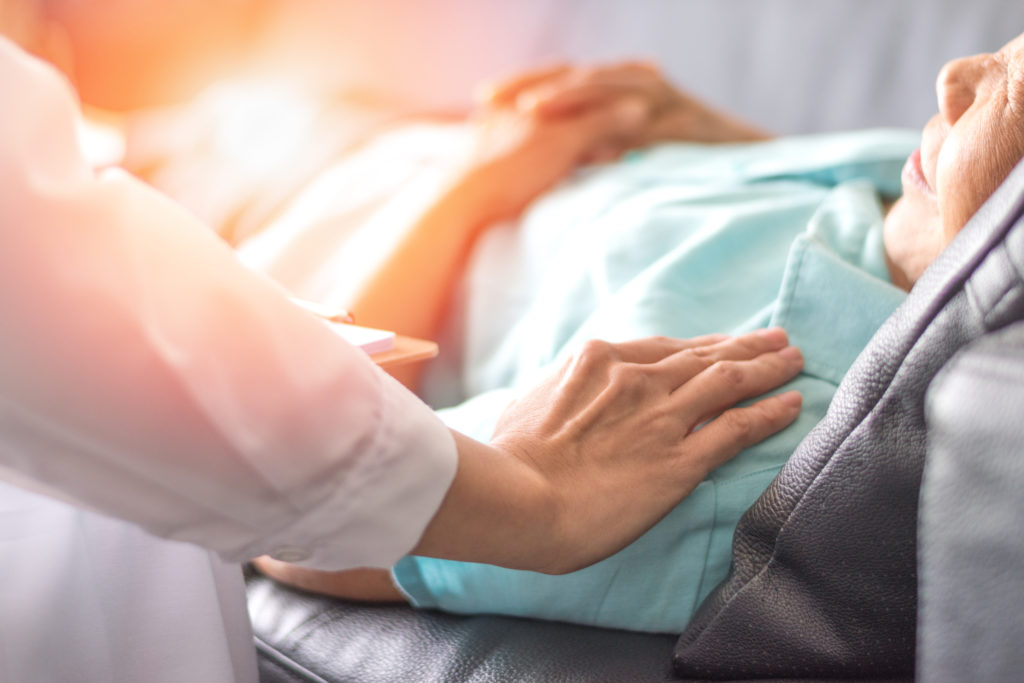
Honoring our patients’ wishes
California’s End of Life Option Act (EOLOA) allows terminally ill adults (with 6 months or less to live) to request aid-in-dying medication.
We always honor our patients’ beliefs, values, and choices. If a patient wishes to exercise their legal option to access aid in dying, we provide a safe, supportive environment.
We will work with the primary care physician to help everyone involved understand the legal protocols, and will provide comprehensive physical, emotional, and spiritual care to the patient, along with support for family members and loved ones.
For more information about the Act and how we support your decision, read this overview. You can read our policies and procedures about the Act here.
Supporting families
Read Joel McKinney’s story of his dad’s decision to take aid-in-dying medication, and how Mission Hospice supported the entire family.
Find out more about our support for who those are grieving the loss of a loved one.
Supporting children through grief
Hospice care offers wraparound support for all family members, regardless of their age. Support for children who are facing the death of a loved one is an important part of our bereavement care.
 “Children are often called the forgotten mourners,” says bereavement counselor Isabel Stenzel. “A child’s life is forever changed by the death of a parent or close family member. We really do acknowledge grief in children and support the grief needs of the entire family.”
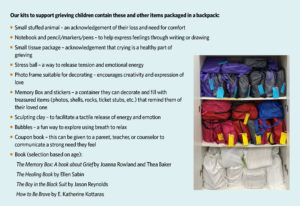
Our bereavement team has long provided individual counseling and play therapy for children who are grieving. Thanks to funding from our community, we can now provide extra support for young people who have lost a parent or primary caregiver.
A generous grant from Sandhya’s Touch, a foundation dedicated to improving quality of life for people with chronic or serious illness, funded supplies for several projects, including our new grief kits for children who are grieving a loss.
Isabel explains, “These kits allow us to reach and support so many more young people in ways that can impact their emotional health for years to come.”
“Grieving parents can be overwhelmed and find it difficult to get a child to bereavement counseling – especially in a pandemic world,” she says. “The idea is to offer a variety of age-appropriate resources that young people can explore – with a social worker or spiritual counselor, or on their own.”
Isabel convened a committee – including volunteer Wendy Parker, a retired school psychologist and counselor – to determine what would be most therapeutic for young grievers. Based on that research, the team developed and created kits with resources specifically designed to support ages 5-8, 9-12, and teens.
Our staff and volunteers have been getting special training on supporting grieving children. Jaymie Byron, LMFT, Director of Community Outreach at our community nonprofit partner Kara, led a special workshop on helping children cope with loss.
Jaymie emphasized that children act differently to grief, crisis, and trauma depending on their age and development. In addition, as they develop, children will re-experience the death in new ways and reintegrate the relationship that has been lost.
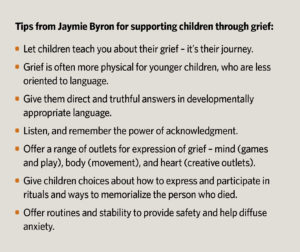 Understanding how children experience grief, and being better able to support them, is a key part of our ability to serve the entire family. As Linda Goldman wrote in her book, Life & Loss, “If a child is old enough to love, he or she is old enough to grieve.”
Care team keeps patient and family safe and supported throughout pandemic, wildfires, power outages, and more
The power of teamwork in our patient care manifests itself in many ways. It shows in attention being paid simultaneously to a person’s physical, emotional, and spiritual well-being. It shows in the coordination between clinical and administrative staff to ensure that necessary medicines, supplies, and equipment arrive – and that the patient and family understand how, when, and why to use them. And it shows in the personalized support we provide to patient and family alike, sometimes at all hours.
While teamwork and holistic care are a natural part of hospice, as a nonprofit agency – with generous support from our community – we can offer a level of care that goes above and beyond, and we can serve patients regardless of their insurance or ability to pay. In special circumstances – like last year’s terrifying intersection of a pandemic, wildfire, and power outages – that teamwork and level of care are taken to an extraordinary level.
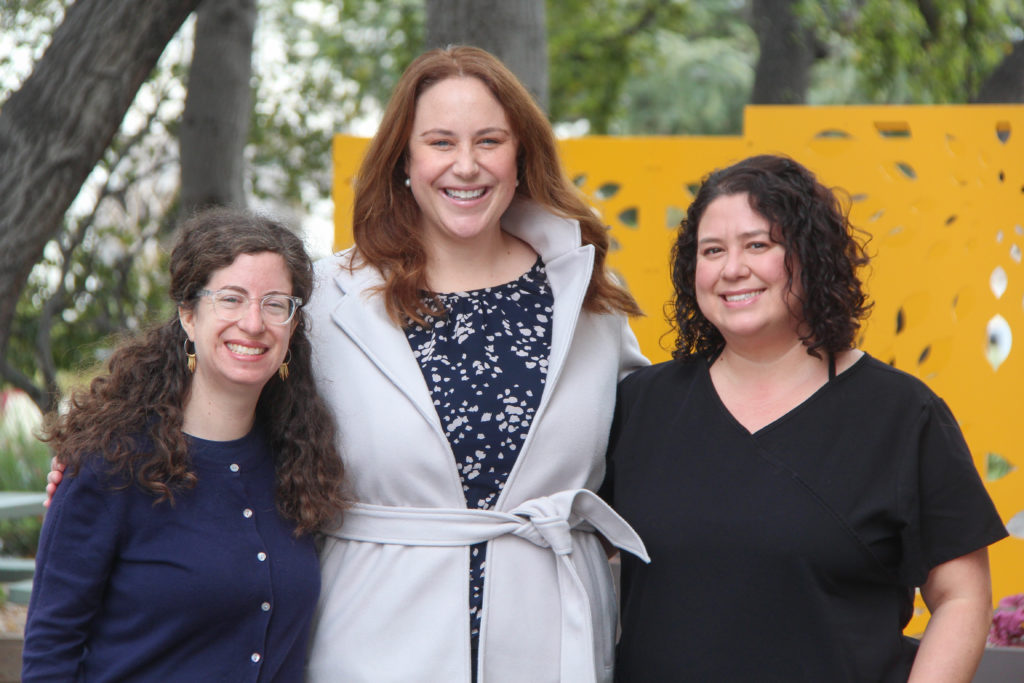 Since August 2020, Nurse Practitioner Michele Cronin, RN Case Manager Lydia Claesson, Social Worker Tess Murphy, and Spiritual Counselor Rachel Rosenberg have been supporting our patient Barbara after she decided to stop her cancer treatment and begin hospice care. (This article uses a pseudonym to protect her privacy.)
While Medi-Cal helps cover the costs of Barbara’s hospice care, the Mission Hospice team has gone to great lengths to provide for her other needs. She has a history of trauma, so they started by laying a foundation of honesty to earn her trust. They had no way of knowing just how important that trust would become as they helped her through the emergencies of 2020.
Barbara lives with her husband in rural San Mateo County, where – just after she started hospice care – the CZU Lightning Complex fires ignited. The team worked furiously and closely to see that Barbara, her husband, and their pets were able to evacuate safely.
Tess procured hotel vouchers so the pair – and their pets – had a place to stay. Even this was challenging: soon after they had been evacuated, that site was itself evacuated. The family wound up staying in a series of hotels during the two-week evacuation order.
“It was pretty crazy,” says Tess. “We worked together to be sure we all knew where they were, and that they were safe.” One of the logistical challenges they faced was arranging for Barbara’s medications to be delivered to various hotels.
Fortunately, the family’s home survived the wildfire, and their community rallied around them to donate things they needed as they returned home. The Mission Hospice team coordinated with San Mateo County Health specialists, who arranged for meal delivery for Barbara and her husband. They completed an application to PG&E’s Medical Baseline Program to reduce the family’s electricity and gas costs. And they requested – and received – a donation from Saint Vincent de Paul for cremation services to be provided after Barbara dies.
But just two months after the evacuation, the entire community suffered power shutoffs. Again, the Mission Hospice team went into overdrive, making sure Barbara had what she needed. “We checked on her regularly,” Lydia says, “to support her not only through the power outages, but also through the fear of additional fires.”
The team also looked at her comfort and safety inside the home. They helped Barbara make changes to reduce fall risks, and made sure she understands how, why, and when to use medications. Lydia also reminds her to use breathing exercises and music to reduce anxiety and pain.
Spiritual Counselor Rachel has shared music, prayer, and conversation with Barbara; the pair often sing together. “Rachel allowed this patient to explore all of the aspects of her illness and her upcoming death, and come to terms with her relationship with God,” says Lydia. “She feels at peace.”
“She knows we are there for her,” says Lydia. “I can’t overstate how important the team component is in her care. We consult each other regularly, to share information and make sure we are in agreement about how best to care for her. We’ve acknowledged as a team how intimate this relationship and journey are,” says Lydia. “Honesty is at the forefront of it all.”
That honesty has paid off. “She doesn’t feel alone,” Lydia says. “She knows that she has people on this journey with her who truly care for her, and whom she trusts. The fact that she’s able to understand and express this is like a gold medal for us.”
Listening is the greatest gift we can give
Patricia Matthews, longtime Direct Care Volunteer and recipient of the 2020 Special Recognition award, explains: “All persons need to feel that their lives had purpose, and that their time here has mattered. It is an honor to bear witness, to be a keeper of memories, and to be entrusted with patients’ stories.” In her nearly 20 years of service, Patricia has heard many.
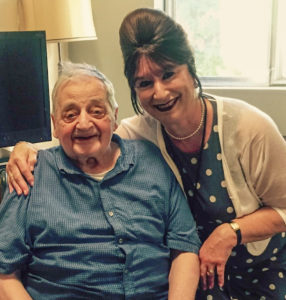 Even though memory loss is a challenge for some patients, hope can come in unexpected places, as it did for Patricia’s patient Francis. He could never remember Patricia’s name, but he knew that she visited regularly, and called her “my faithful Friday visitor.”
Having lost some 50 years of memories – including those of his marriage and children – he still enjoyed sharing stories of his life growing up in Holland and his journey to the U.S. Patricia took Francis on a virtual walking tour of his hometown in Holland, and he was able to find his home, his father’s bakery, and his school. “He was so delighted,” says Patricia. “He thought it was magic!”
Patricia is fluent in French and Italian, and she loves it when she can share her Italian heritage with her patients. “Sometimes we travel to their countries via books, scrapbooks, family albums, or the iPad. Sometimes I bring a particular food, or we listen together to opera. Both food and music can be evocative and can bring back meaningful memories.”
One of Patricia’s patients, a lovely Italian woman in her 90s, asked Patricia where her family was from. “I told her she would never have heard of it, although it was close to Lucca. I said the name of the village. She put her hands to her cheeks, and tears came to her eyes. It was the village where her father had come from – my grandparents must have known him!”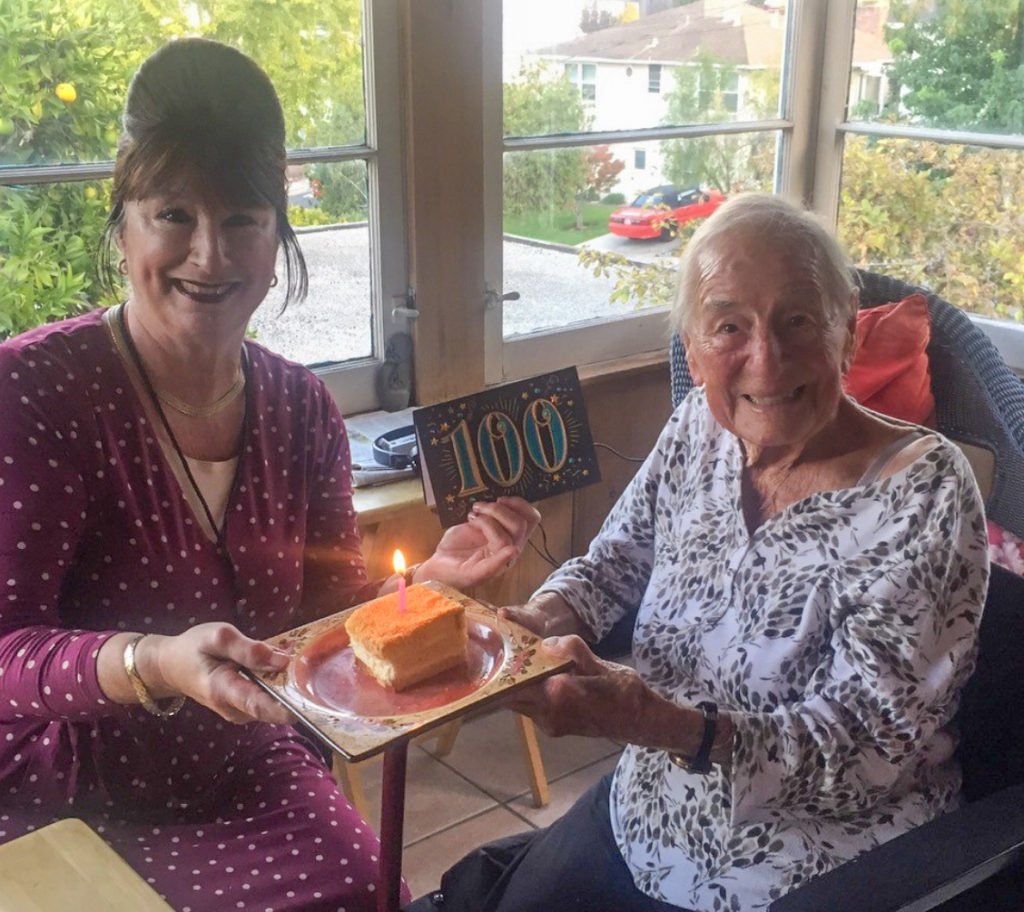
Another Italian patient, Clara, lived to celebrate her 100th birthday. Patricia says Clara “was an inspiration because she chose joy each day. She embraced life, and did not look at what she had lost, but at what she still had.”
One day, Patricia mentioned to Clara that she and her husband were planning a trip to Italy. “When Clara casually mentioned how wonderful it might be if I went to visit her family, I had to do it.”
Without knowing just which bakery was owned by Clara’s family, Patricia and her husband somehow found it – and were immediately embraced and kissed, as Clara was the beloved matriarch of the family. “They gave us pastries and we shared an aperitivo. It was such a special opportunity for all of us.”
“Being a hospice volunteer has given me some of the richest moments of shared humanity in the most intimate of deep physical and spiritual moments one could ever imagine,” says Patricia. “It is an honor and a privilege to accompany a patient on the last part of their journey in this life.”
To learn more about volunteering with Mission Hospice, join us for an online info meeting on March 23, 2021.
What is spiritual care?
by Renshin Bunce, MDiv, Chaplain
August 2020
To say “chaplain” is to invoke an image of a religious professional, perhaps a man in a reverse collar, who enters at a time of crisis and resolves problems with a really good prayer. That image is out of date. As chaplaincy is practiced now, the care we offer is spiritual – not religious. The fact that I’m a Zen Buddhist priest, and that I trained as a chaplain as a way of carrying my vow into the world, is helpful to me, but in a visit, what’s important is what my patient believes and needs.
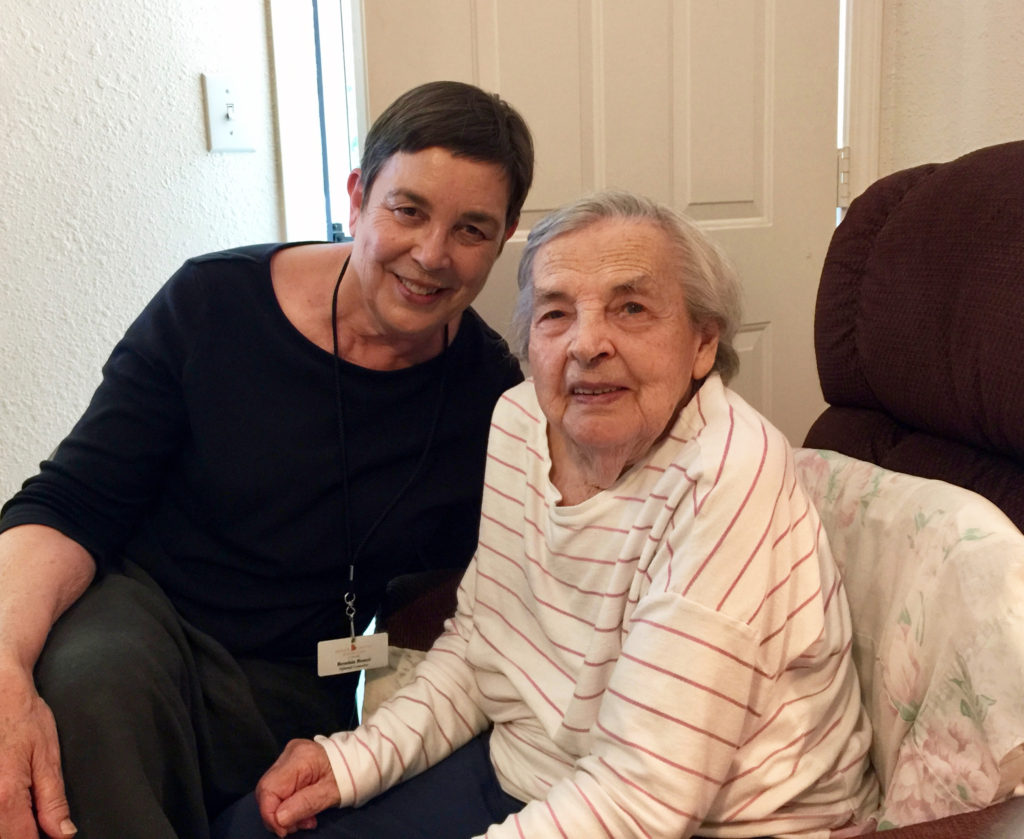 I entered a monastery when I was in my 50s because of a deep yearning for answers to the question of suffering. After seven years, I entered a one-year hospital residency so I could leave the monastery and find work as a professional chaplain. Zen meditation develops an ability to sit still and not turn away from difficulty, which turned out to be great training for working with hospice patients and their family members.
Very early in my residency, I was called to the ICU in the middle of the night. A man in his 50s was dying; his wife was with him. Neither of them wanted my help – it was her sister who had asked for a chaplain. As I sat in the hallway listening to the sounds of suffering and sorrow and wondering what I was supposed to do, I realized that my presence could remind everyone that dying is not just a physical event. This means showing up and listening – really listening – to the answer when I ask a patient or family member how they are doing. And after that come words: explanations, reassurances, and comfort and prayers.
During the time of COVID, that physical presence is gone. I no longer sit by the bedside of people who are lost in dementia, drop in on lonely people in facilities, or visit patients and loved ones in their homes. Now I talk on the phone. It’s been a trick to learn how to bring presence to a method of communication that’s based primarily on words. Fortunately, it can be done.
When I started my training, I thought my job was to “fix,” but I’ve come to see that as both arrogant and impossible. Who am I, after all, to say that another is broken, or that I’m so powerful that I can or should change the course of a lifetime in a few visits?
What seems clear to me after a decade visiting dying people is that mostly we want to know that we’re seen and heard. Whether it’s over the phone or in person, that’s my goal in my work as a hospice chaplain.
Grief in the time of COVID-19
by Bereavement Coordinator Isabel Stenzel, LCSW, MPH
During these unprecedented times brought on by the COVID-19 pandemic, the Mission Hospice community is sheltering in place along with people across the globe. For those who have lost a loved one, physical isolation can intensify the grief experience. When we feel fear and anxiety, such as during this pandemic, we naturally yearn for security by wanting our loved ones close to us. Missing your loved one can heighten feelings of self-doubt and even lower self-confidence. You may wish they were here to share in this time and wonder what they would do. Yet there can also be a sense of relief that your loved one does not have to cope with this pandemic, including concerns about caregiving and seeking medical care at this time.
 Even if you haven’t lost a close loved one, it is understandable to feel grief at this time. Many have experienced disappointments with cancellations of plans. We miss our friends, grandchildren, and we miss touching and hugging our loved ones. We’ve also experienced the loss of choices, freedom, job security, financial security, and routine, among many things. We’ve lost freedom to engage with groups; it will take time to feel safe again in crowds. We have lost our illusion of full control. Naturally, we might react to these losses with denial, defiance, or irritability, judgment, and frustration towards others.
Grief is more complex now, especially for those with underlying depression or anxiety. Having traditional funerals and taking care of practical affairs are not possible. Of course, losing a loved one to COVID-19 and not being able to be with them physically at the end of life is devastating. There is collective grief with the enormity of loss around the world to this virus, especially among the less privileged.
Most importantly, this pandemic forces us to look at our vulnerability and contemplate the possibility that we, too, can catch this virus, and could die. This fear motivates us to stay home. At Mission Hospice, we know that death is a natural part of life. Yet modern health care has altered our relationship with death. Death feels more controllable, distant, something that happens at advanced ages or to the unlucky. Yet we are all vulnerable.
This epidemic is a chance to ponder not only our own mortality, but our lives. Have we lived well? What is our legacy? What is left unfinished, and how will I live my life going forward to fulfill my values and goals? Consciously and deliberately practicing personal death awareness can make death less scary, and help us face death with curiosity, wonder, and surrender, rather than fear and avoidance.
For anyone bereaved, grief may feel like it is “on hold” until sheltering is lifted. And many of the choices we have that serve to distract us from grief and help us feel alive are difficult: going out to movies, hanging out with friends, shopping, and traveling. Having something to look forward to can help in grief; right now, we are all in a holding pattern, waiting with uncertainty when this will be over. This all asks us to be patient.
In grief it can be helpful to take turns focusing on grief and then setting it aside. Even at home, we can find ways to honor our loved ones by creating an altar, lighting a memory candle each day, journaling, and reviewing photos. Talking to our loved ones in our heads is natural and can offer comfort. What would he say? What would she want for you? Being stuck at home and feeling bored forces us to feel… feel the grief, acknowledge it, allow it. We cannot run away from it.
Some people stuck at home are cleaning closets and experiencing an upsurge of grief with so many reminders. Yet we can also focus on chores, cooking, reading, enjoying music, watching shows and working on projects. We must be mindful of the tendency towards negative thoughts and balance them with positive thoughts — by consciously choosing to focus on sources of hope, blessings, and gratitude in our lives despite our grief.
Loneliness is a typical emotion in grief, and it can be heightened during sheltering in place. One way to look at grief is that grief is a form of love. The pain of loss is in direct proportion to the love we have felt for the person. The love we feel for our special person who died never dies, but it changes. Likewise, so many things we love have changed because of COVID-19. Our love of hugs and close-togetherness has been altered. Thankfully, we can still socialize remotely — by phone and the internet.
Sharing grief can reduce its intensity, yet we have to find creative ways to connect to others. We can meditate on how many ways we are still interconnected with others: the food we eat was picked by farmers, packaged by workers, delivered by truck drivers, and sold by store clerks. The medication we take was prepared by a chain of helpers, and the news we hear comes from a long list of researchers and journalists. Even if it feels like it, we are never truly alone! And, Mission Hospice staff are still available to answer questions and provide support. Our grief support offerings include online support groups as well as individual grief counseling by phone and video.
Grief is one of life’s hardest experiences. Ultimately, love is the strongest antidote to grief. Allowing love, enduring love, honoring love, and passing it on is what heals grief. When the energy of grief permits, reaching out and helping others less fortunate can keep us connected. We see this inspiring generosity all around us during this pandemic.
As Penny Nixon noticed, “Love spreads more quickly than any virus ever could.”
Mission Hospice and COVID-19
Across the globe, COVID-19 has disrupted lives and challenged us to adapt to difficult circumstances. While so much has changed, one thing that’s remained constant is our commitment to providing compassion, care, and kindness. Mission Hospice continues to support patients and families in the San Francisco peninsula and south bay with personalized, compassionate end-of-life care, grief support, and education. We have been serving this community since 1979, and we are here for you.
Patient care
The health of our patients, staff, volunteers, and community members is our priority, and we are monitoring and following the recommendations of the San Mateo County Health Department, California Department of Public Health, and Centers for Disease Control and Prevention.
Throughout the pandemic, we have continued to provide patient care in patients’ homes, facilities, and our hospice house, with all necessary precautions. As always, we have an RN available by phone 24/7. We are accepting new patients across all of our programs. If you or someone you know may be considering hospice, please call us at 650.554.1000 and ask to speak with our Clinical Outreach team.
Our teams are going above and beyond to provide care – through the pandemic, and even through wildfires and power outages. Read the story of one team here.
- 100% of our patient-facing staff is fully vaccinated.
- To minimize the spread of COVID-19 and to protect the health of our patients, our staff, and our community, our staff will ask screening questions in advance to determine if anyone in the family may have been exposed to COVID-19. Any family members exhibiting respiratory symptoms are requested to move to a separate room during our visit.
- Your nurse case manager will be checking in with you regularly to assess your needs. If you have any questions or concerns, please call us at 650.554.1000.
- Mission House patients and families should contact us directly for the latest visiting protocol.
Grief support
Many people, even those who haven’t lost a loved one, are experiencing grief at this time – and we have suggestions about how to manage grief during COVID. Our grief support groups and workshops have moved online, where we are reaching more people than ever. Check our Events calendar for the current status of all events.
We also offer individual grief support by phone and video. For information, please call us at 650.554.1000.
Community education
Our wide range of community education programs are now online, providing opportunities to learn and talk about how to live and die well. From our popular author and movie series to presentations from nationally recognized experts in resiliency, grief, and advance care planning, these virtual programs have become a resource for people around the world. Check our Events calendar for the current status of all events.
The pandemic has more people thinking and talking about advance care planning. We have moved our free Take Charge series online, where we can help people plan for their future care based on what matters most to them. Our Take Charge Toolkit and other advance care planning resources remain free and available to all on our Take Charge page.
Resources for our community
We urge everyone to follow the restrictions and guidelines in place. For all of us, and especially for caregivers, self-care is very important right now. You can find resources for caregivers here.
This two-minute video explains the importance of washing with plain soap and water.
Grief is more complex now, especially for those with underlying depression or anxiety. There is collective grief with the enormity of loss around the world to this virus, especially among the less privileged. Our bereavement coordinator Isabel Stenzel has written about grief in the time of COVID-19.
We also recommend these tips for managing the contagion of anxiety from Psychology Today, this BBC guide on How to protect your mental health, and this meditation for anxiety and stress from Love, Serve, Remember Foundation.
During uncertain times, it’s normal to want someone to talk to. For non-hospice-specific grief and/or loneliness, please consider these free resources for phone support:
- Institute on Aging’s Friendship Line: 800.971.0016
- Dignity Memorial’s Compassion Helpline: 866.649.9641
- Contra Costa County 24-hour Grief Hotline: 800.837.1818
- StarVista’s 24/7 Crisis Hotline: 650.579.
0350
Seeking donations
We are most grateful for the way our entire community has come together during this crisis. As we navigate into the future together, we are so grateful to our donors for their ongoing support, which is more important now than ever before.
Compassion and kindness
In the more than four decades since our founding, Mission Hospice has always been known for the compassionate care we provide – not only for our patients and families, but also for one another.